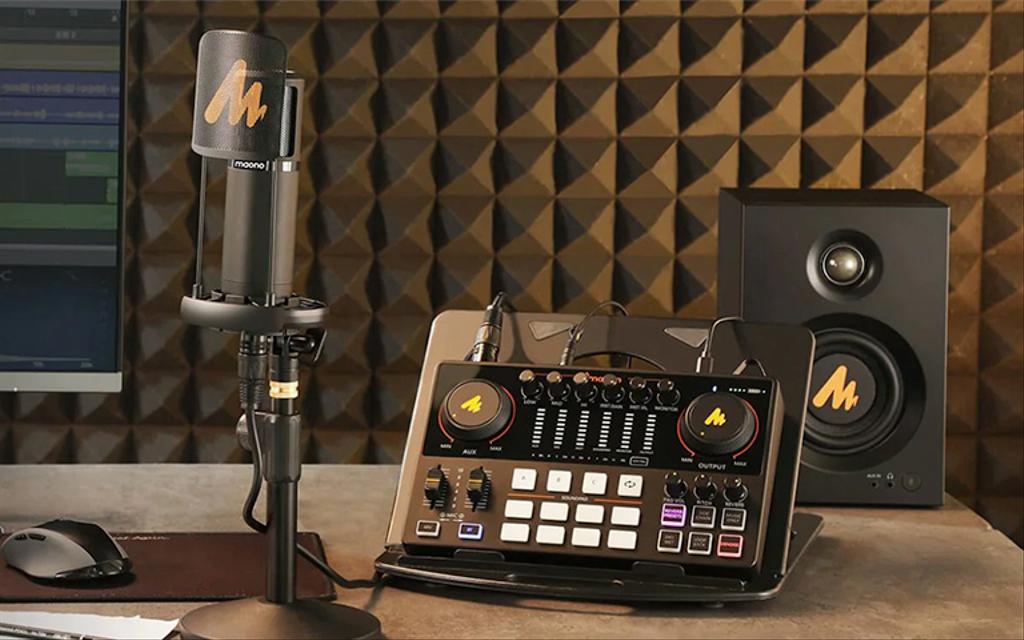
The Maonocaster E2 is one of the most frequently recommended budget podcasting mixers for hosts who need two XLR inputs and a complete hardware bundle under $200. At The Podcast Consultant, we’ve seen it work well as a starting point for solo and two-person shows, particularly for financial advisors and B2B hosts recording from a home office who aren’t ready to invest in a dedicated audio interface and separate podcast microphone.
The key limitation to know upfront: the E2 cannot record to an SD card. It requires a live computer connection, which makes it unsuitable for field recording or travel setups. If that’s a dealbreaker, the ZOOM PodTrak P8 ($499.99) is the better choice. If a desk-based two-person setup under $200 is what you need, read on.
Key points:
- Best for: Solo or two-person shows recording from a fixed home office setup with a computer present
- Key limitation: No SD card recording — must be connected to a laptop or desktop to capture audio
- Sound quality caveat: The preamp introduces some hiss at higher gain settings; not suited for professional broadcast-grade production
- Upgrade path: When your show grows beyond two in-person guests, the TASCAM Mixcast 4 or RØDECaster Pro 2 are the next logical steps
Table of Contents
- The Maonocaster E2 At A Glance
- Maonocaster E2 features
- Maonocaster E2 Hardware
- How To Use The Maonocaster E2
- What Is the Difference Between Maonocaster E2 and Maonocaster Lite?
- Alternatives to the Maonocaster E2
- The Bottom Line on the Maonocaster E2
- Frequently Asked Questions
- Can the Maonocaster E2 record without a computer?
- Does the Maonocaster E2 work with USB microphones?
- What is the difference between the Maonocaster E2 and the Maonocaster AME2A?
- How does the Maonocaster E2 compare to the Maonocaster Lite?
- Is the Maonocaster E2 good for a two-person podcast?
- What causes the hiss some users hear with the Maonocaster E2?
- Can you import custom sounds to the Maonocaster E2 sound pads from a computer?
- How long does the Maonocaster E2 battery last, and can you use it without being plugged in?
- Who should consider upgrading beyond the Maonocaster E2?
The Maonocaster E2 At A Glance
The Maonocaster E2 costs $169.99, connects via USB-C, records at 24-bit/48kHz, and bundles a PM320T mic, shock mount, metal pop filter, stand, earphones, and two TRRS cables with a 12-month warranty.
What can you expect from the Maonocaster E2? We’ve put some key details in this handy chart.
| Recording Media | USB Connector | Sampling Rate | Inputs and Outputs | Included Items | Price |
| Not compatible with SD cards – requires a direct connection to your laptop, tablet, or desktop | USB Type-C | 48kHz | Bit Depth: 24-bit / 48kHz WAV (AME2A variant: 32-bit chipset) | 2 channels in, 2 channels out | Earphones, shock mount, metal pop filter, USB A-C charging cable, 2 TRRS audio cables, user manual, 12-month warranty, PM320T microphone, mic stand | $169.99 USD |
Keep reading to get a full breakdown of the Maonocaster E2

Maonocaster E2 features
The Maonocaster E2 includes 2 XLR mic inputs, 48V phantom power, 11 sound pads, Bluetooth, 3-band EQ, autotune, and 8-hour battery life. The AME2A bundle adds an XLR mic, stand, shock mount, and pop filter.
The Maonocaster E2 (also sold as the AME2A bundle) is a USB mixer with two XLR inputs, onboard phantom power, and Bluetooth. It ships with a microphone, pop filter, and stand, so you can complete a two-person recording setup for under $200. That bundle value is its main selling point — for a broader look at complete starter kits, our podcast equipment bundles guide covers options across all price points. The tradeoff is preamp quality: at higher gain settings (above ~50dB), the E2 introduces audible hiss that cleaner interfaces at higher price points avoid. For conversational business podcasts recorded in a quiet office, this is usually manageable. For shows with critical audio standards, it is a real limitation.
The basic E2 bundle comes with:
- Two mic inputs: You have one XLR and one 3.5 mm jack so you can record with different mics. There are microphone sliders attached to each so you can adjust their gain separately.
- Two headphone jacks: Every guest can listen to their own audio while hosted on your show — see our podcast headphones guide for compatible options. Keep in mind these are 3.5 mm jacks — you can’t use anything with USBs.
- Three preset audio effect buttons: You can choose between reverb presets, wet/dry effects, sidechain, loopback, and music-only filters. There’s also a denoise that eliminates self generated noise from the device as well as gets rid of room tone.
- 11 customizable sound pads: Buttons A through C can store 60 seconds of audio, while the remaining buttons store 20 seconds. Keep in mind you can’t pull sound bites off your computer — they have to be recorded by the Maonocaster itself.
- Autotune: Hitting the ‘autotune’ button lets you tune your mix to one of 12 steps. You can chain this effect with other built-in adjustments if you’re looking to create a unique sound.
- Bluetooth connection: You can wirelessly connect your phone to play background audio for your show. You can’t connect microphones, headphones, or other hardware through this connection, though.
- Phantom power: Pressing the phantom power button activates 48 volts for your microphones. Just tap it again to turn phantom power off.
Maonocaster E2 pros
- 48V phantom power means you can use most XLR condenser microphones, including the Rode PodMic and Audio-Technica AT2040, without a separate power supply or inline booster.
- The E2 is portable with an 8-hour built-in battery, no wall outlet required during recording sessions, which makes it usable in conference rooms or client offices.
- Your purchase includes a mic, mic stand, and pop filter.
- Every purchase comes with a 12-month warranty and a 30-day money back guarantee.
Maonocaster E2 cons
- This mixer doesn’t support USB microphones.
- Although you can directly connect your iPhone to the mixer via an OTG adapter cable, the audio quality may be poor. Android devices have much clearer audio, which means this limitation largely depends on the phone you use.
- You can’t import sounds to your sound pad through a computer. Instead, you have to record on the Maonocaster itself.
- The preamp introduces audible hiss at gain settings above approximately 50dB. This is manageable in a quiet, treated room but noticeable in untreated home office environments. Podcasters who use dynamic microphones requiring high gain (such as the Shure SM7B) should consider a higher-quality interface.
You can’t record directly to the mixer like you can with the TASCAM Mixcast 4 or ZOOM PodTrak P8, so you can’t use an SD card to capture recordings. You need to record on your tablet or computer before promoting and publishing your podcast.
Maonocaster E2 Hardware
Every E2 bundle ships with a PM320T condenser mic, shock mount, metal pop filter, mic stand, earphones, USB A-C cable, two 3.5mm TRRS cables, and a user manual backed by a 12-month warranty.
There’s a user manual in every bundle, so you can assemble its components accordingly.
Each bundle comes with:
- Your Maonocaster E2 model
- Earphones
- One shock mount
- A metal pop filter
- A USB A-C charging cable
- Two TRRS audio cables (3.5mm)
- Your user manual
- A 12-month warranty
- A PM320T microphone
- A basic microphone stand
There are a number of accessories you can add to the bundle, including:
How To Use The Maonocaster E2
Setting up the Maonocaster E2 takes 12 steps. The most critical: connect to your recording software before enabling phantom power — reversing that order triggers feedback spikes.
Follow these 12 steps and you’ll avoid the most common issues.
It takes 12 steps to set up your Maonocaster E2:
- Open your box and remove the microphone. You can put this together by first screwing the shock mount to the stand, then installing the microphone to the shock mount.
- Install the pop filter on top of the microphone. Feel free to consult your user manual for guidance.
- Connect your E2 to its power cord. The mixer should have eight hours of battery life when fully charged.
- Plug your XLR cable into the back of your mic and connect it to your E2.
- Adjust your gain to a suitable level. Maono recommends 40dB for condenser mics and 60dB for dynamic mics.
- Connect your E2 to your recording device (likely a computer or tablet with Adobe Audition or similar podcast recording software).
- Tap the power button to switch on the E2.
- Adjust your knobs to control the volume.
- Turn on phantom power and connect your headphones to the monitor.
- Change your computer’s input device to the E2 (if it hasn’t changed automatically).
- Adjust your inputs, outputs, and pitch as desired.
- When you’re ready to record, start recording on your device (or livestreaming, depending on your setup).
Keep in mind you can always refer to your user manual if you get confused during setup.
More of a visual learner? This 20-minute video covers these steps in greater detail.
What Is the Difference Between Maonocaster E2 and Maonocaster Lite?
The Maonocaster E2 adds XLR input, 48V phantom power, and a second headphone jack compared to the Maonocaster Lite. The Lite is ~$40 cheaper but lacks phantom power and XLR support.
Maono sells several consumer-grade mixers, the most popular of which include Maonocaster the E2 and the Maonocaster Lite (also referred to as the AM200). The biggest difference between these two is that the E2 comes with phantom power and an XLR microphone input — something the Lite model does not have.
The Lite also comes with 12 soundpad buttons (only four of which are customizable) and pre-loaded audio. This is different from the E2, which offers 11 customizable buttons with no pre-recorded audio.
Other differences between these two mixers include:
- Headphone jacks: Maonocaster Lite only has one headphone output. The E2 has two.
- Mic gain setting: In contrast to the E2, there’s no gain setting on the AM200.
- Podcast output: There are two USB-C outputs with the E2 and three with the Lite.
Here’s a table to sum this up:
Alternatives to the Maonocaster E2
The three strongest alternatives are the Maonocaster Lite (roughly $40 cheaper, comparable quality), plus two other options covered below — worth considering if the E2’s feature set exceeds your current needs.
Concerned that the Maonocaster E2 doesn’t offer what you need?
Let’s look at three of our recommended alternatives — starting with the Maonocaster Lite.

Maonocaster Lite
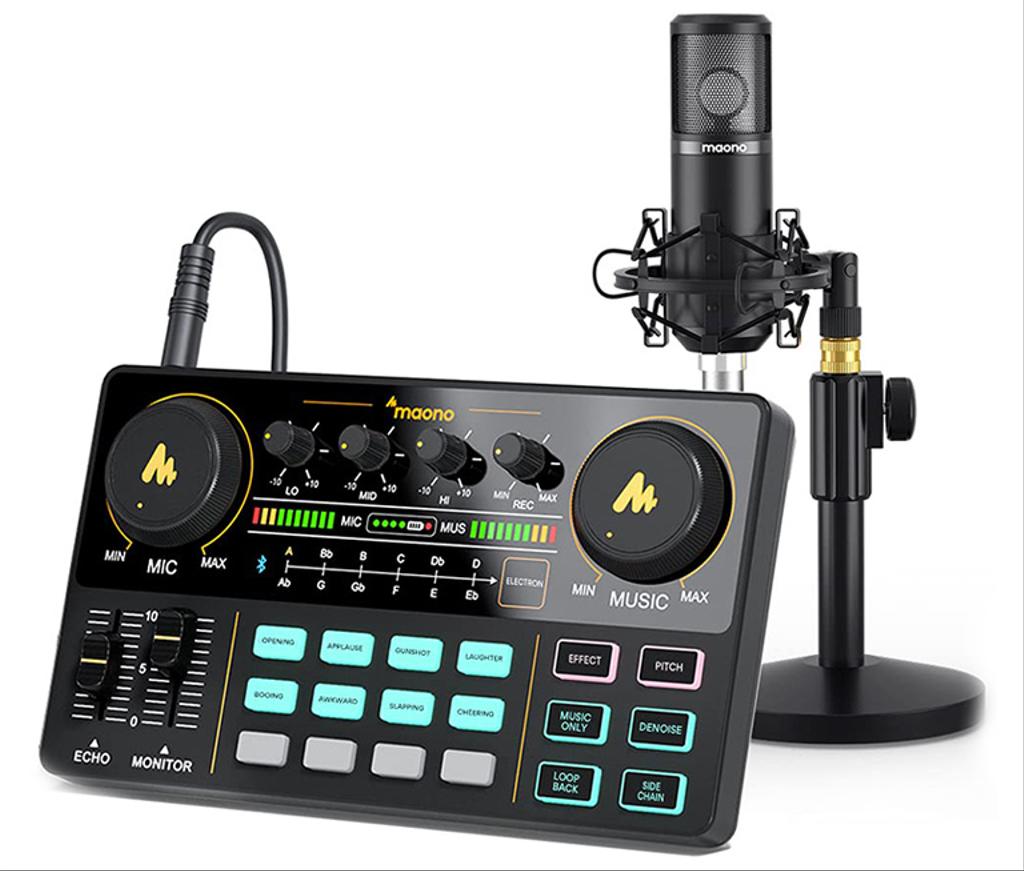
As mentioned, the Maonocaster Lite is a more compact version of the Maonocaster E2. This version also comes with a (non-XLR) mic and stand so you can start recording right away. It may have fewer customizable sound buttons and just one headphone output port. However, it’s roughly $40 cheaper than the E2, which means you can get comparable quality with very little sacrifice.
For more details, check out our full guide to the Maonocaster Lite.
TASCAM Mixcast 4
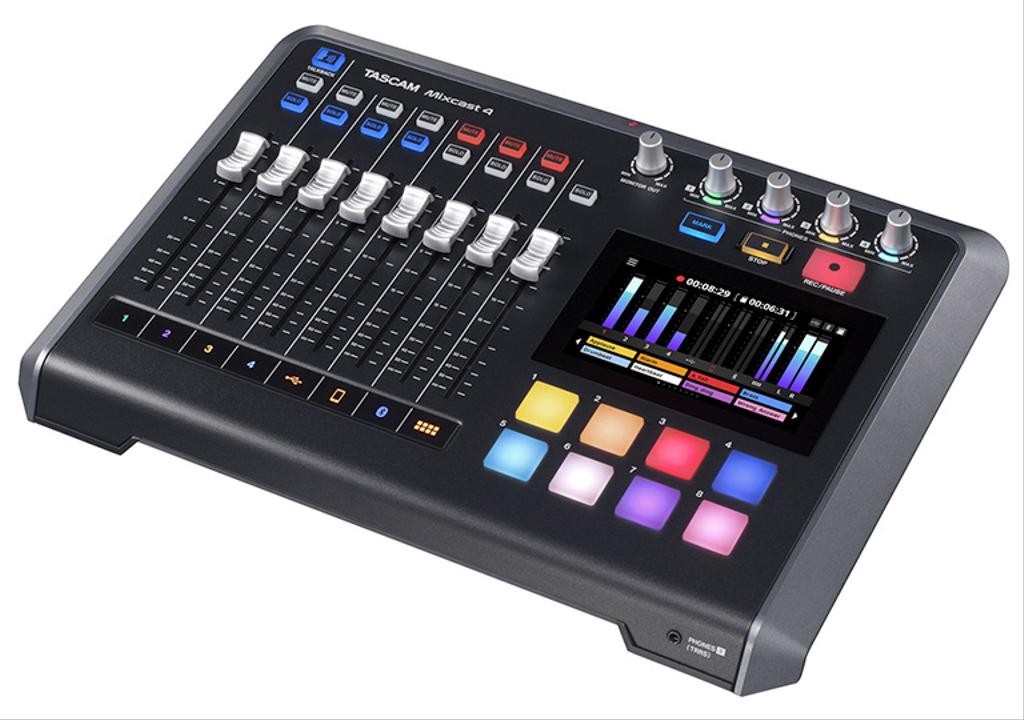
Unlike the Maonocasters, the TASCAM Mixcast 4 records audio directly to an SD card. It also comes with four mic inputs so you can have more people on your podcast at once. Since the touchpad screen can help you edit audio directly, you don’t need to do as much cleanup later.
If you want to read our summary about the TASCAM Mixcast 4, feel free to check out our article about it here.
ZOOM PodTrak P8
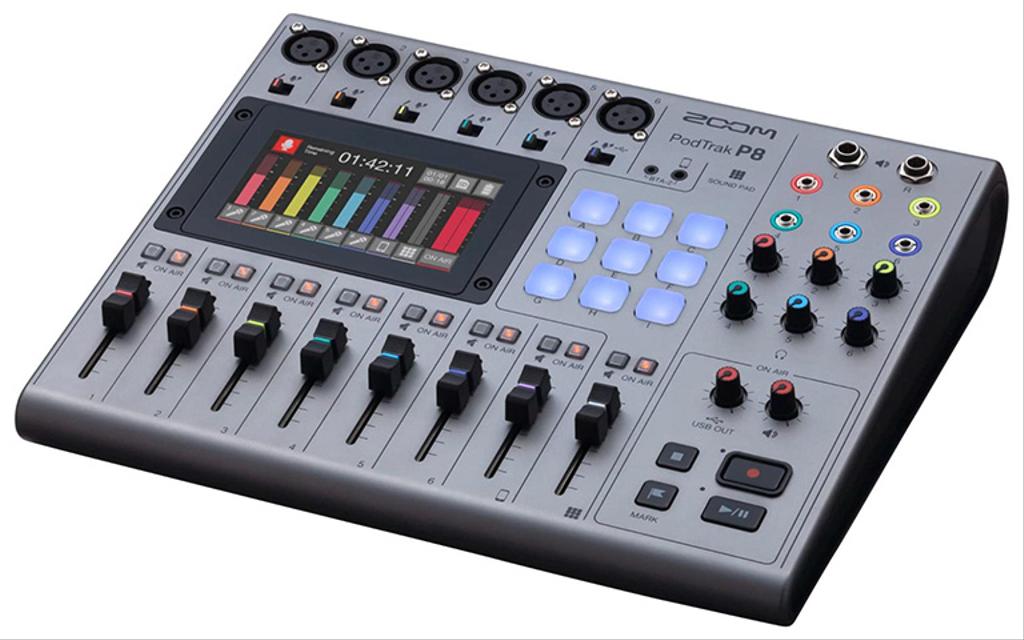
The ZOOM PodTrak P8 is referred to as a prosumer device, which means it’s marketed to experienced podcasters who are familiar with audio mixers. With the P8, you can connect up to six XLR microphones, take call-ins via phone or Bluetooth, and customize 36 sound pad options with audio imported from your computer. At $499.99, it’s approximately three times the price of the E2 but it includes SD card recording and significantly cleaner preamps.
You can explore these features in greater detail in our ZOOM PodTrak P8 guide.
The Bottom Line on the Maonocaster E2
The Maonocaster E2 suits business podcasters and B2B producers upgrading to XLR — solid for audio-only shows or paired with a video setup, as long as you have editing software ready to refine the output.
Just be sure to give some thought to how you want to edit your audio, including the software you need to refine your final product.
Just be sure to give some thought to how you want to edit your audio, including the software you need to refine your final product. If you want help from professionals, The Podcast Consultant would be happy to assist with the launch of your podcast or even do podcast video production for you. We can also audit your existing podcast so you can make future episodes even better.
Want to learn more about our podcasting services? Just book a discovery call.
Frequently Asked Questions
Can the Maonocaster E2 record without a computer?
No, the Maonocaster E2 requires a live connection to a laptop, desktop, or tablet to capture audio. It does not support SD cards, so you cannot record directly to the device itself. If you need standalone recording, the ZOOM PodTrak P8 or TASCAM Mixcast 4 are better fits.
Does the Maonocaster E2 work with USB microphones?
No, the E2 only supports XLR microphones through its two XLR inputs. USB microphones are not compatible with this mixer. If you already own a USB mic, you would need to upgrade to an XLR model to use it with the E2.
What is the difference between the Maonocaster E2 and the Maonocaster AME2A?
The Maonocaster AME2A is essentially the same mixer sold as a more complete bundle, adding an XLR microphone, stand, shock mount, and pop filter. The core hardware and feature set are the same between the two. The AME2A variant also uses a 32-bit chipset, compared to the standard 24-bit version.
How does the Maonocaster E2 compare to the Maonocaster Lite?
The E2 is the more capable of the two, adding 48V phantom power, XLR input support, and a second headphone jack. The Lite costs roughly $40 less and comes with pre-loaded sound pad audio, but its sound buttons offer a fixed set of audio options. If you plan to use a condenser microphone, the E2 is the better choice.
Is the Maonocaster E2 good for a two-person podcast?
Yes, it is well suited to solo and two-person shows recorded at a fixed desk setup. It provides two XLR inputs with independent gain sliders and two headphone jacks so both hosts can monitor audio during recording. It works best in a quiet, treated room to keep preamp hiss under control.
What causes the hiss some users hear with the Maonocaster E2?
The onboard preamp introduces audible noise when gain is pushed above roughly 50dB. This is noticeable with dynamic microphones that require high gain, such as the Shure SM7B. In a quiet, acoustically treated space with a condenser mic, the hiss is usually manageable for conversational podcast formats.
Can you import custom sounds to the Maonocaster E2 sound pads from a computer?
No, you cannot load sounds directly from your computer onto the sound pads. All custom audio must be recorded onto the pads using the Maonocaster itself. Buttons A through C hold up to 60 seconds of audio, while the remaining pads hold up to 20 seconds each.
How long does the Maonocaster E2 battery last, and can you use it without being plugged in?
The E2 has a built-in battery rated for approximately eight hours of use. This means you can run it in a conference room or client office without needing a wall outlet during recording sessions. However, you still need a computer connection to actually capture the audio.
Who should consider upgrading beyond the Maonocaster E2?
If your show grows to include more than two in-person guests, you will quickly outgrow the E2’s two XLR inputs. Podcasters who need SD card recording, cleaner preamps, or more advanced mixing controls should look at the TASCAM Mixcast 4 or the ZOOM PodTrak P8. Both cost significantly more but offer a meaningfully higher feature set and audio quality.