
Stepping into the world of podcast production can feel like a daunting journey. At The Podcast Consultant, we’ve launched 100s of shows and produced tens of thousands of podcast episodes, turning the complex process of podcast editing into actionable processes that elevate your podcast to its highest quality. It’s all about finding the right balance: knowing when to cut, when to adjust, and when to enhance. This comes from years of experience and technical skill. But it’s more than just that; it’s about understanding the unique essence of each host and their podcasts and bringing it to life. In this article, we’re excited to share the intricacies of our approach to podcast editing. From helping you choose the perfect editing style to enhancing your podcast’s voice, to our thorough quality-control measures that ensure your podcast sounds incredible and connects meaningfully with your listeners.
Table of Contents
- The Basics of Podcast Editing
- Choosing The Right Editing Style For Your Podcast
- A Systematized Approach to Podcast Editing
- Why Hiring Professional Podcast Editors Makes All The Difference
- The Bottom Line
- Frequently Asked Questions
- What does professional podcast editing actually include?
- What are the five podcast editing styles, and how do I choose the right one?
- How does The Podcast Consultant maintain consistent editing quality across so many episodes?
- What four areas does your quality control process focus on?
- How are podcast editors assessed and reviewed?
- Why should I hire a professional editor instead of editing my podcast myself?
- How does editing benefit my podcast guests?
- Can your editing team work on any type of podcast show?
- How do you handle filler words and crosstalk during editing?
The Basics of Podcast Editing
Podcast editing covers audio balancing, noise reduction, EQ, content cuts, and sound design to produce a polished, engaging episode. Editing styles range from raw and unfiltered to premium, where every detail is fine-tuned.
Whether you’re in the early stages of your podcasting journey, producing bite-sized content, or have been recording your podcast for years, mastering the art of podcast editing is crucial for ensuring your content shines. Quality editing is more than just cutting out the awkward silences and the occasional slip-up; it’s about enhancing the overall listening experience and ensuring your audio and video podcasts are as polished and engaging as possible. Visit our detailed guide on podcast metrics to better understand how to measure your podcast’s success and areas for improvement.
The Benefits of Editing Your Podcast
For You: Precise editing lets you control your podcast’s narrative and flow, ensuring your content is delivered as intended. It can also help you avoid common pitfalls like mismatched audio levels or unwanted background noise, which can distract from the message you’re trying to convey.
For Your Guests: A well-edited podcast creates a seamless conversation that can make both you and your guests sound more articulate and focused. It also means your team can address any technical issues before your episode goes live, preventing potential embarrassment and maintaining the professional quality of your show.
For Your Listeners: It’s a simple fact—listeners prefer quality in a world where anyone can start a podcast; those that offer crystal-clear audio and a smooth listening experience stand out. Effective editing doesn’t just remove the bad; it enhances the good, keeping your audience engaged and coming back for more.
The Anatomy of Podcast Editing
Editing a podcast might seem like a black box for those not versed in audio production. Let’s unravel the mystery, breaking down the anatomy of a podcast edit into its core components. From balancing audio levels to weaving in music and sound effects, each step is crucial in crafting an episode that engages, informs, and entertains — and it all starts with what comes out of your recording platform.
The basic podcast editing stages:
Audio Balancing: Adjusts the volume levels of voices, music, and sound effects to ensure a smooth listening experience.
Noise Reduction: Eliminates or significantly reduces background noises, such as hums, buzzes, and random disruptive sounds, to enhance audio clarity.
EQ (Equalization): Tweaks the tonal quality of the audio, ensuring that voices sound natural and clear, which can involve enhancing specific frequencies while diminishing others.
Content Editing: Involves cutting out parts of the conversation that don’t add value, like lengthy pauses, filler words (“um,” “like,” “uh”), compliance-related removals, and repeated information, making the podcast more engaging and to-the-point.
Intro and Outro Integration: Seamlessly incorporates the podcast’s intro and outro segments, including any sponsorship messages or calls to action, to frame the episode cohesively.
Sound Design: Adds intro and outro music, sound effects, and sometimes ambient sounds to enrich the storytelling, set the tone, and create a more immersive listening experience.
Podcast Editing Styles and Techniques
Each podcast editing style has its flavor, varying from lightly edited up to heavily edited, with differing levels of give and take regarding how relaxed (or surgical) the edits will be. All of these categories incorporate client requests and specifications into the style itself, and the combination of these factors ultimately plays a role in how an audience might receive (and enjoy listening to) your podcast.
At The Podcast Consultant, we have categorized these qualities into five editing styles:
- Raw – Unfiltered and uncut, delivering content in its most authentic form.
- Natural – Lightly polished to preserve the conversation’s genuine flow.
- Conversational – Smoothly edited for fluidity, maintaining a casual tone.
- Standard – Comprehensive editing, ensuring a clean, professional finish.
- Premium – The pinnacle of editing precision, fine-tuning every detail for impeccable audio quality.
This spectrum allows for a tailored approach, ensuring your podcast’s personality shines through.
Choosing The Right Editing Style For Your Podcast
Choose an editing style that matches your show’s intended tone, conversational and loose, or tight and informative. Consider how your hosting style, filler-word tolerance, and crosstalk preferences should shape your editor’s approach.
Understanding your editing needs is a crucial step. Whether seeking a casual tone or a more refined delivery, identifying the right editing style is essential for preserving your podcast’s personality.
When it comes to editing, there are a few things you should be asking yourself: Do I want a casual, conversational tone or a surgical, informative one? How will my hosting style be best preserved (or amplified) by my editor? Am I particular about prominent filler words or, ya know, the more subtle ones? Is crosstalk (people talking over each other) an issue to clean up, depending on how I recorded my episode? Should it feel like a talk show or a TED Talk?
A Systematized Approach to Podcast Editing
The Podcast Consultant uses a three-part quality framework, systematizing expectations, assessing and refining editor skills, and scaling with precision, to ensure every podcast episode meets a consistent, measurable standard regardless of who edits it.
- Systematizing Expectations
- Skills Assessment and Refinement
- Scaling with Precision
Systematizing Expectations
Defining Clear Standards
The best way to ensure consistent quality is by designing a system defining clear standards. You can’t hit a target if you don’t know where (or what) it is. By laying out our internal expectations and then training our team to adhere to them, the bar is set very high and equally hard to miss. Clear expectations create exceptional quality, both internally and externally.
> If you can’t measure it, you can’t manage it.
Peter Drucker
Only by having a systematized framework can our bar be set and maintained.
Quality Control
Our top-down quality control system measures our editing team’s skills, both during training and upon quarterly reviews. By quantifying and isolating the problem areas we’ve encountered across thousands of podcast episodes, four key areas always require close attention:
1. Low-hanging fruit (breaths, lip smacks, stutters, mouth noise, misc noise)
2. Technicals (mic bleed, splicing, surgical cuts, cross talk)
3. Flow (content, pacing, interjections)
4. Fillers (um, yeah, right, like, ya know, sorta, kinda)
Generally speaking, these four categories cover many problem areas that require an editor’s attention when working on an episode. We’ve even laid it out into a quick reference cheat sheet you can download below:

Our dedicated approach to setting precise standards, combined with our vigilant quality control system, ensures that every detail, from the slightest breath to the pacing of content, is polished to perfection.
Skills Assessment & Refinement
With our systematized expectations set, hiring, training, and developing our editing team is where The Podcast Consultant’s robust podcast production system comes to life. While there is always a certain amount of feel or instinct involved in editing, we’ve used our quality control system to build a large team of editors that can work interchangeably on virtually any show.
Initial Assessment
For newly hired editors, we have them edit three episodes with extensive hands-on coaching and sample the first fifteen minutes of each training episode. Doing it this way allows us to understand their overall habits, editing patterns, strengths, and weaknesses. It quickly reveals which areas will require the most training (or re-training) to meet the standards we set at The Podcast Consultant.
If you’d like to join our growing team of top-notch editors, we’d love to hear from you!
Quarterly Editor Reviews
Just like The Podcast Consultant does podcast audits for your shows, we also diligently audit our editing team. Both when hiring a new editor or reviewing an existing one during quarterly reviews, we use a scoring spreadsheet to test (and assess) an individual’s skills. Using our quality control system, we lay out all the focus areas in a spreadsheet and assign a score to each value to grade performance and adherence to the standard.
Here is a look at an editor undergoing their quarterly review:

The scoring system works as follows:
5 = 0 occurrences of the given problem flagged during the review
4 = 1-5 occurrences flagged
3 = 6-10 occurrences flagged
2 = 10+ occurrences flagged
1 = 20+ occurrences flagged
As you can see, in these 3 sample episodes, a handful of loud and distracting breaths were found left, some crutch words were unremoved, and a few other things we caught after completing our assessment. Generally speaking, anything over a 4 is fantastic, and anything beneath that requires extra care going forward. Even then, if an editor scored a 4 in a given area, we will still encourage micro-improvement to strive for 5’s across the board.
We then take that data and plot it into a spider chart, which gives us a quick visual reference of skills:

We then add each editor’s scores to a staff spreadsheet, allowing us to see the strength of our team as a whole and showing us which members require more hands-on training in specific areas to have them all consistently knocking it out of the park episode after episode.
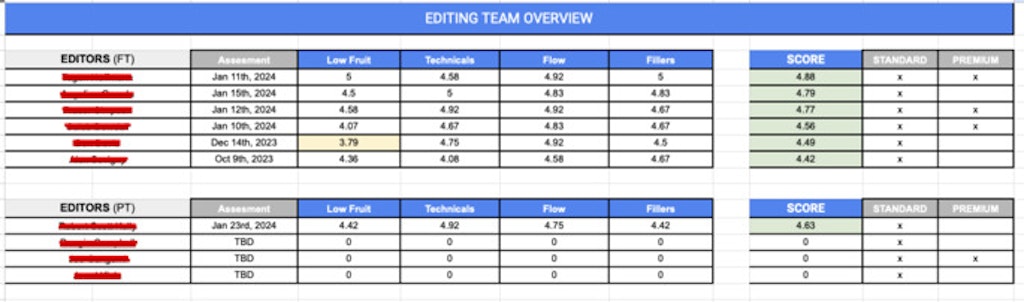
Our rigorous assessment and refinement process underscores our commitment to excellence. We meticulously evaluate and enhance our editors’ skills to ensure your podcast sounds amazing.
Scaling With Precision
One of the most significant advantages of having a universal standard at The Podcast Consultant is that it streamlines our editing team, allowing us to scale more quickly. While feeling and nuance are always required from editors, having our entire team go through the exact training and review process allows the production team to tag any of our editors in and out of an episode at a moment’s notice, resulting in flexibility to respond to an influx of edit requests quickly. This way, if anyone is sick, away on holiday, or decides to move on to another network, we can continue to cater seamlessly to our client’s needs and maintain our pace effortlessly.
Our clients can confidently air their episodes knowing every last detail has been combed over for precision and perfection, regardless of who worked on it that given day, week, or month.
See what our clients have been saying.
Why Hiring Professional Podcast Editors Makes All The Difference
Professional podcast editors bring trained ears, technical precision, and editorial intuition that software and self-editing cannot replicate, freeing you to focus on content while ensuring every episode sounds polished and retains listeners.
Maximize Your Creative Focus
Launching a podcast comes with its own set of challenges, from conceptualizing content to engaging your audience. There can be many moving parts to producing a high-quality show, and editing is one of the most critical components to help elevate it and keep your audience engaged with your content. Unless you plan on being the next Joe Rogan and have zero editing done to your show, or have hours and hours of spare time to devote to the steep technical learning curve of mastering podcast editing yourself, this simply isn’t feasible. This is where the expertise of professional editors, seasoned through hundreds or thousands of episodes, becomes invaluable. They ensure your content reaches its highest potential, allowing you to concentrate on what truly matters: your message and your audience.
Invest in Quality: A Non-Negotiable for Success
While it’s possible to DIY certain aspects of your podcast, such as artwork, show notes, or other social media assets for your podcast, audio quality shouldn’t be one of them — that’s where professional podcast editing services come in. The clarity and delivery of your sound are essential, directly influencing listener retention and enjoyment. Professional editors possess the unique set of skills to refine your audio subtly, ensuring even the most articulate guests sound better, and that the final product feels effortlessly coherent.
Podcast editing software like Descript can be a good starting point for beginners, however, time and time again, we’ve found that it cuts too aggressively into words, leaving abrupt edits in the audio. We almost always end up smoothing each cut out for clients manually. There’s a delicate balance between technical proficiency and the editor’s intuition that software alone can’t achieve.
Related Articles:
- The Ultimate Guide to Podcast Editing Software
- Adobe Audition: The Ultimate Guide for Pro Podcast Production
- Is Reaper the Best Podcast DAW of 2025?
- REAPER DAW: The Best DAW for Audio Production in 2025
- Descript for Editing: Mastering Podcast Edits
- Hindenburg Pro: Transforming Podcast Production
- GarageBand: Simple Audio Production for Mac and iOS
- Adobe Podcast: AI Tools
- Adobe Enhance
Bad editing is obvious, but great editing is invisible.
The Bottom Line
Professional podcast editing delivers quality that exceeds audience expectations, freeing you to focus on content while experts handle production complexities, making every investment in your podcast worth it.
At The Podcast Consultant, we understand the complexities and nuances of podcast production inside and out. Our dedication to maintaining the highest quality is not just about employing technical skills; it’s about embracing the art of storytelling, enhancing the unique essence of your podcast, and ensuring every episode resonates deeply with your listeners. Through our systematic approach—encompassing clear standard definitions, skill assessments + refinements, and optimizing our team for scaling—we guarantee exceptional quality that sets all of our clients’ podcasts apart.
Our team of passionate and knowledgeable experts is committed to freeing you to focus on your creative vision, all while we handle the intricacies of podcast production. Investing in professional podcast editing with TPC means investing in your podcast’s success, ensuring it not only meets but exceeds your audience’s expectations. In the end, the content you create is a reflection of your connection to your listeners, and by partnering with The Podcast Consultant, you’re choosing to present them with nothing but the best.
Discover How TPC Can Transform Your Podcast
Curious about taking your podcast to the next level? The Podcast Consultant specializes in fine-tuning existing podcasts and launching successful new ones. With our expertise, you can effortlessly navigate the complexities of podcast production. Our tailored podcasting services are designed to meet the unique needs of B2B brands. From detailed audits to comprehensive launch strategies, we provide the support you need to stand out in the crowded podcast space. Schedule a discovery call with us to uncover the ideal next steps for your podcast’s success.
Frequently Asked Questions
What does professional podcast editing actually include?
Professional podcast editing goes well beyond cutting out mistakes. It covers audio balancing, noise reduction, equalization, content flow, intro and outro integration, and sound design. The goal is to make every episode sound polished and keep listeners engaged from start to finish.
What are the five podcast editing styles, and how do I choose the right one?
The five styles range from Raw, which is completely unfiltered, to Natural, Conversational, Standard, and Premium, which involves precision fine-tuning of every detail. The right choice depends on your tone, hosting style, and how much cleanup you want applied to things like filler words or crosstalk. Asking yourself whether you want a talk-show feel or a TED Talk feel is a good starting point.
How does The Podcast Consultant maintain consistent editing quality across so many episodes?
The process is built on three pillars: systematized expectations, skills assessment and refinement, and scaling with precision. Clear internal standards define exactly what quality looks like, and every editor is trained and regularly reviewed against those same benchmarks. This removes guesswork and keeps quality consistent whether it’s your tenth episode or your thousandth.
What four areas does your quality control process focus on?
The quality control system zeroes in on low-hanging fruit like breaths and mouth noise, technical issues like mic bleed and crosstalk, flow elements like pacing and content cuts, and filler words like um, yeah, and ya know. These four categories cover the full range of problems that appear in editor reviews and form the foundation of every editor review.
How are podcast editors assessed and reviewed?
New editors complete three coached training episodes, with the first fifteen minutes of each sampled to identify habits, strengths, and weaknesses. Existing editors go through quarterly reviews using a scoring spreadsheet that grades performance across all quality control focus areas. Scores are then visualized in a spider chart so strengths and weak areas are easy to spot at a glance.
Why should I hire a professional editor instead of editing my podcast myself?
A professional editor brings technical expertise and trained instincts that take years of hands-on experience to develop, freeing you to focus on researching, interviewing, and developing your ideas. Your creative energy goes toward the work that only you can do, and the production quality reflects the care your show deserves. Outsourcing editing lets you focus on what makes your show worth listening to in the first place.
How does editing benefit my podcast guests?
A well-edited episode makes guests sound more articulate and confident, even when the original recording had technical hiccups or awkward moments. Any audio issues are caught and corrected before the episode goes live, which protects both your guest’s reputation and the credibility of your show. Guests are far more likely to share and recommend an episode they feel proud of.
Can your editing team work on any type of podcast show?
Yes, because all editors are trained to a universal standard, they can work interchangeably across virtually any show format. The systematized training process ensures consistent output regardless of which editor handles a given episode. This also makes it easier to scale production without sacrificing quality as your show grows.
How do you handle filler words and crosstalk during editing?
Filler words and crosstalk are treated as distinct editing categories, each requiring its own level of attention and judgment. The right approach depends on the editing style you choose and your preferences as a host, since some podcasters want every filler word removed while others prefer a more natural feel. Editors are trained to apply the standard that matches your show’s personality and your agreed-upon editing style.